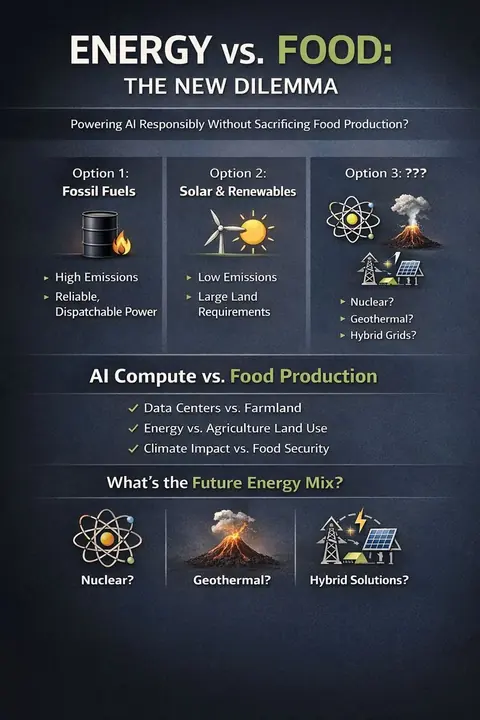
I first heard about the “food vs energy” concept during undergrad. At the time it felt abstract. Academic. Now it's operational.
With the recent partnership between OpenAI and AMD, aiming for 6 gigawatts of compute capacity, we need to confront a hard question: where does 6 GW of power come from? For context, 6 GW is roughly the power needed for millions of homes. This is industrial-scale, grid-shaping demand.
There are only a few realistic pathways.
Option 1: hydrocarbons
Reliable. Dispatchable. Scalable. But it comes with significant GHG emissions, long-term climate costs, and increasing regulatory and ESG pressure.
Option 2: solar and renewables
Low operational emissions. Politically favourable. But low energy density means massive land requirements, intermittency, and large-scale land-use trade-offs.
And here's the uncomfortable part: large solar deployments compete for land. Land grows food. The old academic debate resurfaces in a new form: AI compute vs food production.
We are entering an era where AI is accelerating across every sector, models are growing, inference demand is scaling globally, and data centres are becoming critical energy infrastructure. Every prompt, every training run, every deployment increases compute demand.
This is not an anti-AI argument. It's a systems argument. Energy is no longer just a backend constraint; it's becoming a strategic bottleneck. The food vs energy debate used to be about biofuels. Now it's about data centres, land use, grid capacity and climate targets.
The real question isn't “should we scale AI?” It's “how do we power AI responsibly without distorting food systems or accelerating emissions?” Nuclear? Advanced geothermal? Hybrid grids? Energy-optimised model architectures? Compute efficiency breakthroughs?
The next decade won't just be shaped by better algorithms. It will be shaped by better energy decisions.
Reference: lnkd.in/grhAXUnD