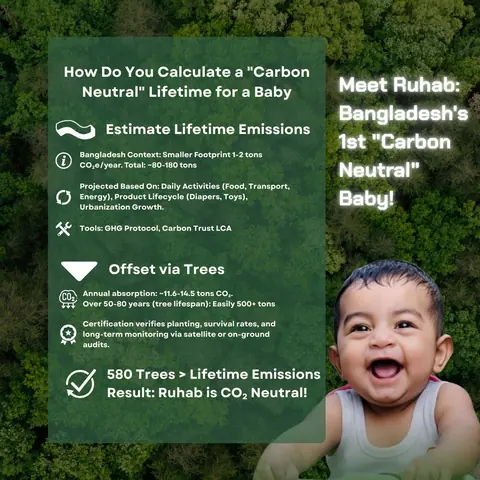
In a world racing against climate change, one Bangladeshi family is planting seeds of hope, literally. Ruhab, the newborn son of Imran Rabby and Aysha Akter, has been certified as Bangladesh's first carbon-neutral baby. His parents planted 580 trees in Satkhira to offset his entire lifetime carbon footprint.
True sustainability demands transparency in our calculations, so let's break down the math.
1. Estimate lifetime emissions
For someone in Bangladesh, the average annual footprint is around 1–2 tons of CO₂e. Over an 80–90 year lifespan, that's about 80–180 tons. For a baby, it is projected from:
- Daily activities: food (local vs imported), transport, energy use
- Product lifecycle: diapers, toys, clothes, cradle-to-grave emissions from manufacturing and waste
- Regional adjustments: Bangladesh's lower per-capita emissions (vs a global average of 4.7 tons a year), though urbanisation could raise it
Tools like the GHG Protocol or Carbon Trust calculators use life-cycle assessment to model this from demographics and lifestyle assumptions.
2. Offset via trees
A mature tree absorbs about 20–25 kg of CO₂ a year. For 580 trees that's about 11.6–14.5 tons a year, and over a 50–80 year tree lifespan easily 500+ tons: more than enough to balance a lifetime. Certification verifies planting, survival rates and long-term monitoring.
Brilliant idea, hard to implement
Idea-wise it's brilliant: it sparks conversations about early eco-habits and community tree planting. Implementation-wise, not so practical. Lifetime projections are guesses (what if Ruhab becomes a jet-setting CEO?), tree survival isn't guaranteed (around 80% in ideal conditions, less in vulnerable areas like Satkhira), and offsets don't address root causes like systemic emissions. Scaling it globally would be a logistical and financial nightmare for most families.